febr. 16 2016
Learning how to produce relational accounts of social change (Soc & Pol Sc degrees)
In higher education learning cannot be reduced to remember facts and follow simple procedures. The Structure of Observed Learning Outcomes taxonomy (here) clearly states deeper levels of learning. Some of the most outstanding assignments of the students who took Social Change and Globalisation at Universitat Autònoma de Barcelona this year (autumn 2015), indicate what a ‘relational’ level of learning is in the area of social sciences.
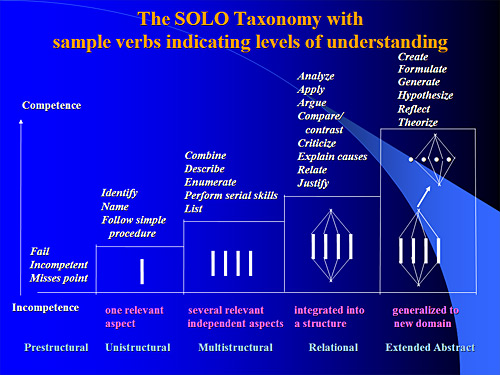
At least, in these contributions you have been able to carry out the following intellectual activities.
Argue: “Certainly agency can trigger development, but if this should happen on a larger scale, agents will have to come together, negotiate shared objectives through compromising differing interests.”
Criticize: “In E. K.´s view, prostitution exists because women do not have another way to earn money, so prostitution is the only job they can get because they are a vulnerable group. However, in my opinion prostitution is a cultural issue, that cannot be solved only with job opportunities or public policies. We also have to consider that prostitution is related to crime, sex trafficking, and the culturally diverse concepts of fertility.”
Explain causes: “On the other hand, arguing for the spread of Western culture of gender equality has its weak points. Firstly, tradition and culture are deeply incorporated into a society and change very slowly. Globalization advances extremely quickly and there is no way that local cultures will adopt Western cultures at the same velocity. Second, globalization and the “wave” of Western culture spreading throughout the world often rather creates resentment. People being overwhelmed by all these new opportunities and products often tend to emphasize their own identities.”
Justify: “For me the answer for the question is simple – there will never be something like a global governance. If such a thing was achievable, humans would have built it straight after the II World War to truly guarantee peace, development and prosperity (…) The second argument I would like to mention is the conflict of cultures. According to H., there are nine civilizations who have different point of view on many topics. For ages they had different value systems (…) The last argument I think of, is the example of quasi-governance that is the EU. Almost 30 countries partly resigned from their sovereignty in favour of the European. Parliament, the Commission, the Court of Justice and so on. However, everything began with economic integration, but political integration is failing- the Constitution collapsed, Brexit is a real possibility, and nobody is able to make clear decisions concerning the refugees crisis.”
Apply: Some students’ contributions to the forums have applied the core concepts in quite insightful ways. The interaction between the global and the local implications of the financial crisis retrieves the concept of globalisation as a change of the territorial matrix. Similarly, the potential and the hurdles of women’s empowerment as well as the the influence of religion in the making of a global, cosmopolitan consciousness illustrate the role of agency. Last but not least, the Gaza conflict shows to what extent the agency of agents equipped with uneven resources actualises the deep contradiction between ‘idealist’ human rights and ‘realist’ defence strategies in the current system of international relations.
This entry was posted on Dimarts, 16 febrer, 2016 at 16:44 and is filed under L'aprenentatge a l'educació superior. You can follow any responses to this entry through the feed. You can leave a response, or trackback from your own site.